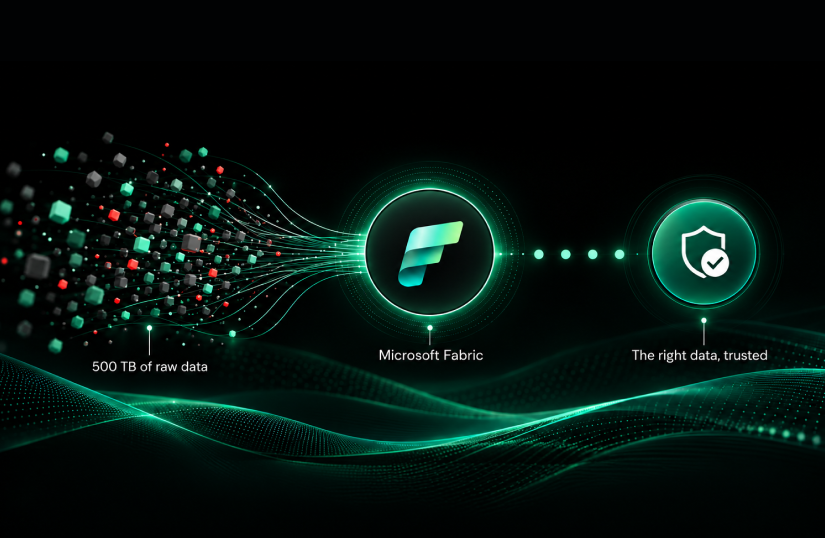
Introduction
Imagine asking an AI assistant, “Which products should we manufacture next month?”
Within seconds, it generates a beautiful dashboard, forecasts demand, and recommends optimized production schedules. Everything looks absolutely flawless, until you peel back the layers and realize the source sales data contains duplicate customer records, missing product codes, inconsistent regional pricing, and legacy inventory figures pulling from three separate operational systems that haven’t synchronized properly for weeks.
The AI didn’t fail. It simply did exactly what it was engineered to do: process and analyze the data it was given. It interpreted unreliable inputs with mathematically perfect precision.
The future of data scaling isn’t about collecting massive, uncurated volumes. It is about engineering absolute trust into every single byte.
As organizations globally rush toward rapid AI adoption, leadership teams frequently operate under the illusion that the newest foundation model, custom agent, or massive enterprise analytics platform will natively solve their core operational challenges. History, however, serves as an unforgiving guide. Over the past two decades, billions of dollars have been lost across failed machine learning initiatives, unmaintained data lake projects, and stalled analytics transformations. These initiatives collapsed not because the computational power or software architectures were inadequate, but because the underlying data completely lacked quality, rigorous governance, and cross-organizational trust.
Today, Microsoft Fabric provides enterprises with a architectural framework to fundamentally decouple from these historic failure modes. The ultimate corporate challenge is no longer a question of data extraction capacity; it is a discipline of data value refinement.
The AI Illusion: Faster Doesn’t Mean Smarter
Modern enterprises generate more diverse transactional and operational telemetry than at any point in history. Data fragments accumulate constantly across structural boundaries:

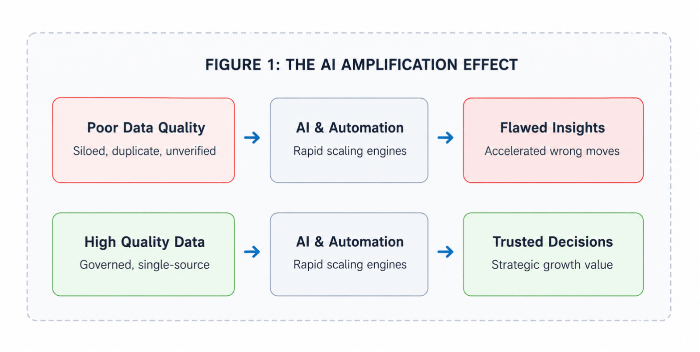
The typical executive temptation is incredibly direct: “If we ingest more data, our artificial intelligence models will naturally deliver smarter business decisions.” Unfortunately, this assumption is fundamentally flawed. Poor-quality data does not miraculously shift into premium value simply because it passes through a multi-billion parameter neural network or an automated vector search database. Instead, AI heavily accelerates and magnifies pre-existing baseline anomalies.
Think of AI as a Formula One engine. If you install that world-class engine inside a chassis that has cracked brakes and flat tires, you will not win the race; you will simply crash significantly faster. In an enterprise analytics setting, this means:
- Duplicate data entries directly transform into duplicated, inflated operational insights.
- Incorrect baseline unit pricing yields structurally incorrect, damaging margins and financial forecasts.
- Missing inventory statuses translate directly into flawed production plans and disrupted supply chains.
- Outdated customer records generate inaccurate, alienating automated recommendations.
Technology never inherently fixes broken human processes or neglected data governance. It simply scales their structural errors.
Data Quantity Is Not Data Value
Many organizations celebrate volumetric milestones as if they represent intrinsic financial value: “We process 50 million transactions a day; we hold 200 Terabytes of raw storage in our cloud lakehouse.” While these storage figures sound technically impressive to engineering teams, corporate executives do not steer businesses based on raw byte metrics. They steer businesses based on the absolute confidence index of their analytics.
Consider a head-to-head comparison between two contemporary organizations operating in the same vertical market:
| Organization A (The Volume Hoarder) | Organization B (The Quality Standard) |
| 500 TB of uncurated, disparate raw data stores | 100 TB of clean, normalized, optimized data assets |
| Multiple duplicate records across fragmented systems | Single unified, deduplicated golden record source |
| Absent or completely passive data governance framework | Strict, active governance with continuous automation |
| Manual, highly reactive data reconciliation cycles | Automated continuous pipeline validation mechanisms |
| Low Executive Confidence: Continuous data disputes | High Executive Confidence: Rapid, trusted execution |
Which organization will repeatedly outperform its competitor in volatile market conditions? Unquestionably, Organization B. Data volume isolated from clear semantic context and verification mechanisms is a pure financial liability. Highly curated, accurate data is an appreciating corporate asset.
Organization A stores 500 TB of data but achieves low AI business value due to its poor Data Quality Score (40). In contrast, Organization B generates significantly higher AI business value with just 100 TB of data because it maintains a high Data Quality Score (90). The figure demonstrates that data quality, not data volume, is the primary driver of AI success.
Why AI Needs Data Quality Before Intelligence
Every automated processing system, from basic regression models to advanced multi-agent Generative AI orchestrations, remains rigidly bounded by a foundational system axiom: Garbage In = Garbage Out. AI architectures do not replace this rule; they merely make its consequences brutally obvious on an enterprise scale.
When bad data feeds AI pipelines, the results are immediate and damaging: hallucinated business trends, unreliable dashboard reporting, highly erratic Key Performance Indicators (KPIs), and a total degradation of internal executive confidence. Once confidence evaporates, employee software adoption collapses completely. Operations teams rapidly abandon advanced tools and fallback to disconnected spreadsheet environments. They do this not because legacy tools are superior, but because they understand and trust their own localized validation over an opaque, untrusted enterprise platform.
The Three Pillars of Trusted Data
High-performing, resilient organizations do not build their digital roadmap from the AI layer downward. Instead, they engineer structural stability from the data foundations upward. This baseline requires three structural pillars:



Where Microsoft Fabric Changes the Story
Historically, maintaining these three pillars required building, stitching, and maintaining completely separate, fragmented technology stacks. Engineering teams were forced to manage disparate platforms for data integration pipelines, cloud data lakes, enterprise warehouses, streaming telemetry, machine learning sandboxes, and business intelligence suites.
Every single boundary between these disparate tools introduced significant integration overhead, unneeded data replication, pipeline sync lags, and governance fragmentation. Microsoft Fabric fundamentally redesigns this landscape by unifying these distinct analytical workloads into a singular, cohesive Software-as-a-Service (SaaS) platform built upon a unified data core: OneLake.
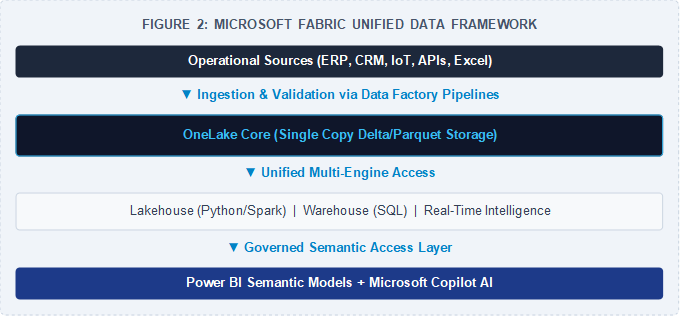
Instead of constantly duplicating and moving data across external processing boundaries, Fabric operates on a “single-copy” architecture. This structural change radically reduces synchronization errors, keeps lineages intact, and gives compliance and governance teams a single control plane to secure and validate data across the entire organization.